Using kittens to explain the power of Scarcity

(True story)

There are 4 kittens in a pet shop…

3 tabby kittens

and 1 black and white kitten

black and white kitten


Fact: Tabby kittens are adopted much more quickly than black and white kittens.

So, which kitten do you think will sell first?

Answer: The black and white one

Why?

The principle of Scarcity

What is the principle of Scarcity?

When something is scarce or rare, people see it as more highly valued and more desirable. This is why shops often have sales and why antiques have such a high value. Scarcity is closely related to the fear of loss – people fear losing what they have and also what they don’t yet have. They will act in sometimes non-sensical ways to avoid this loss (shopaholics and hoarders are good examples).

How do I know the black and white kitten really will be sold first?

Because these kittens have been advertised on the residents board where I live and everyone wants the black and white one.

How to sell more by using scarcity in your website design

  • Limited numbers of a product left? Make this information clear in the interface.
  • Show an end date or time for an offer.
  • Offer something free with the product but limit it’s availability.
Scarcity is a very well know persuader and influencer of behaviour. Once you’re aware of it, you’ll start to see how it is used everywhere so it’s well worth thinking of how you can utilise its power in your designs. 

Amazon use 2 scarcity elements on their product page
amazon scarcity example

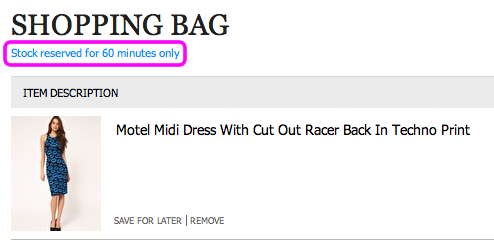
Asos use ‘fear of loss’ to persuade within their basket page
asos

I’m in the news…

salford university carnival

I’ve been featured on Creative Boom talking about the amazing Salford University Carnival held at Islington Mill this week. We had a great time! Below is an extract of the article and if you want to read more just head on over to Creative Boom.

Over a hundred Salford University graphic design students showcased their amazing work at Islington Mill yesterday in a fun carnival themed event organised in conjunction with Designers Northern Alliance.

Representatives from key Manchester and Salford agencies attended the event to inspire and look for the next generation of fresh talent. Keepitusable, Magnetic North, Design by Day, Eskimo Creative, and Code ComputerLove were just some of the industry experts to attend the event.

Lisa Duddington, co-founder of Keepitusable Salford’s first user experience design agency whose clients include the BBC, saw the event as a valuable opportunity to connect with and inspire the next generation of designers.

“It’s so exciting to be part of this event! We know how difficult it can be when you’re first starting your career, so we’re eager to help students and graduates to gain the valuable experience and knowledge they need to succeed in what is an incredibly competitive industry.

We have a fantastic relationship with Salford University and are proud to be able to offer both their students and graduates incredible opportunities to gain industry experience.”

The Clever Little Bag

I just love the amazing design of this new style shoebox by Puma. Most of my shoeboxes are really dull, boring and seriously oversized for the contents. Not only does this new design function well and look cool, it’s easier for the customer to carry and might I add hurts less (doesn’t it hurt when that sharp corner of the box in the carrier bag hits your leg whilst you’re walking?). It’s also economical and saves on packaging so is very eco-friendly and no doubt will save Puma a vast amount of money to produce.

Wouldn’t it be amazing if all companies put this much thought and love into their designs? I’m almost tempted to buy a pair of Pumas now (you see how this works? 😉 when you build great user experiences, people will be attracted to your business, it’s a bit like karma, it pays to care about your users)

An incredibly TAX ing User Experience

“Tax doesn’t have to be taxing”

completing tax return hmrcI can confirm this is the biggest whopper i’ve ever heard. Maybe it’s true if you never touch self assessment yourself and leave everything in the hands of bookkeepers and accountants. But, for the average Joe Bloggs, completing a self assessment for the first time (like I’ve just done) is a very unpleasant, frustrating and stressful user experience.

Completing a self assessment for the first time will:

  • Take much longer than you expect (take a guess then multiply it by at least 5)
  • Confuse the life out of you. The guidelines are so generalised that finding specific answers for your particular situation is nearly impossible.
  • Make you hate the HMRC helpline. They take a lifetime to answer the phone, and you can guarantee that as soon as you hang up the phone you think of one more vital question you should have asked so you have to start the whole process once again.
  • Make you hate all websites associated with tax, in particular the HMRC one. There’s a wealth of information out there but trying to find answers to seemingly simple questions like how to calculate how much NI you owe is very difficult as once again it depends on your particular situation.
  • Make you incredibly fearful of ‘Submit’ buttons.
  • Suddenly make you religious. In your head you’ll find yourself subconsciously saying a little prayer to the Gods of software and internet that your return is submitted successfully.
  • Make you hate Error messages even more than usual.
  • Start treating your computer like a precious object. No one is allowed within a two metre radius of it until the self assessment has been submitted. Each entry and mouse press is taken with extra care to prevent any mistakes being made.

frustrated kit

My expectations of the online user experience for completing your self assessment were that it would be easy. After all I’d seen the adverts on TV and the posters all over in the past claiming ‘Tax doesn’t have to be taxing’. My expectations couldn’t have been more wrong! Firstly I logged into the website using my login details and as I’d already told them I was a partnership I was expecting some kind of wizard to take me through the whole process online. But I couldn’t see any call-to-actions to say ‘Begin here!’ so I found myself aimlessly clicking on every hyperlink I could find. I just couldn’t find the starting point. I felt like Sarah in the movie Labyrinth who can’t work out how to get into the labyrinth.

So I went to my old pal Google. After some time I found an article that mentioned needing software to submit a partnership tax return. This was all a bit odd, I thought you could just use the HMRC site. Anyway it turns out you need to purchase software to submit a partnership return which is why there wasn’t a clear starting point on the website. I wish they’d explained this in big text as soon as I logged in. The site is very much aimed at people who have completed a previous self assessment and know what they’re doing.

I then had the task of trawling through lots of software websites and downloading demos to find something easy to use. This took time… Most were really, really bad. I’m so surprised that something everyone has to do can be made so complex. I’m educated up to MSc level, good with computers and I often have to understand complex problems so I can’t imagine how bad it must be for more novice users.

I finally decided on FTAX as it was basically a pdf version of the actual form. It looked more familiar and it had some intelligence – when you completed fields it automatically calculated other fields. It was still an unpleasant experience. The form started having what looked like a fit at one stage and would not stay on the page I wanted at all. Bear in mind I was feeling quite stressed at this point. The form was obviously evil and deliberately trying to wind me up even more. It wouldn’t behave itself until the following day and I then managed to complete all the fields.

Finally, I plucked up the courage to press the Submit button. It didn’t work. No response whatsoever. More stress. My partner tried it on his machine and hooray it worked! But oh no it failed! Errors written in the worst possible technical language imaginable beamed at me from the screen, giving me their equivalent of the middle finger. After a few attempts at tweaking random things I’m relieved to say that the form did eventually submit itself. Hooray! I can’t wait to go through it all again next year, not. I’ll definitely be employing an accountant next time because as i’ve found out tax IS incredibly taxing and should be left to the professionals until HMRC employ user experience designers to completely redesign the whole software!

An inspiring Saturday at the first ever TEDx Salford!

This weekend saw the first ever TEDx event held in Salford and we were fortunate enough to get our hands on the last tickets. Having never been to a TEDx event before we weren’t sure what to expect but it turned out to be a day full of inspiring and uplifting talks on a whole range of topics by incredibly knowledgeable speakers. From rock stars and explorers to futurologists, CERN scientists and even an astronaut, the event really did have a wide variety of interesting speakers! To read the rest of my post you’ll have to click here as I wrote it for keepitusable.com 

Salford TEDx

The paradox of choice

The video below is of Barry Schwartz talking about the paradox of choice. It’s something that faces us all everyday. Choosing what to buy is not as easy as it used to be. Simply popping to the corner shop to buy bread takes longer due to the enormous array of different types of bread available. Online shopping takes us a lot longer due to the amount of incredibly similar products and the fear that we may make the wrong choice. For the average person, this fear leads to many hours of researching and reading reviews so they hopefully make the correct choice.

Too many choices leads to Paralysis

If you ask them, people will tell you that they like choices. Choices equal freedom. However, as Barry notes in the video, it has been proven that offering more choices actually makes choosing more difficult and ultimately to not choosing at all. More choices actually puts more stress on the person making the choice as they have to weigh up all the pros and cons of each. Eventually they either put it off until another day or they give up altogether. The solution is to offer the consumer less choice. You can also guide them into making the correct choice (or the choice you really want them to make!) via persuasive design.

Making choice easier with persuasive design

Persuasive design

Through intelligent design, we can lessen the negative effects of the paradox of choice. Basecamp’s pricing page has been designed to entice the user to the Premium plan. The benefit of this design is the user feels they have choices (yet not too many) and control yet the decision making is less taxing as it has already been done for them.

I just want coffee flavoured coffee!

The comedian Denis Leary performed a hilarious rant on his Lock n Load tour about how difficult it is to now buy coffee flavoured coffee. It certainly highlights why keeping choices to a minimum is a good thing and less stressful for consumers.


11 Free User Experience Books

Thanks to The UX Bookmark for this great list of free online user experience books!
1.   Search User Interfaces– by Marti A. Hearst
2.   Web Style Guide– by Patrick J. Lynch and Sarah Horton
3.   Designing Interfaces– by Jenifer Tidwell (Most of the book is available online, not all of it, as pointed out by Amanda)
4.   Designing Mobile Interfaces– by Steven Hoober and Eric Berkman
5.   The Psychology of Menu Selection: Designing Cognitive Control at the Human/Computer Interface- by Kent L. Norman 
8.   Building accessible websites– by Joe Clark
9.   Introduction to Metadata – by Tony Gill, Anne J. Gilliland, Maureen Whalen, and Mary S. Woodley
11. Categories for the Description of Works of Art– by Murtha Baca and Patricia Harpring

Presenting at Manchester Met Uni (MMU)

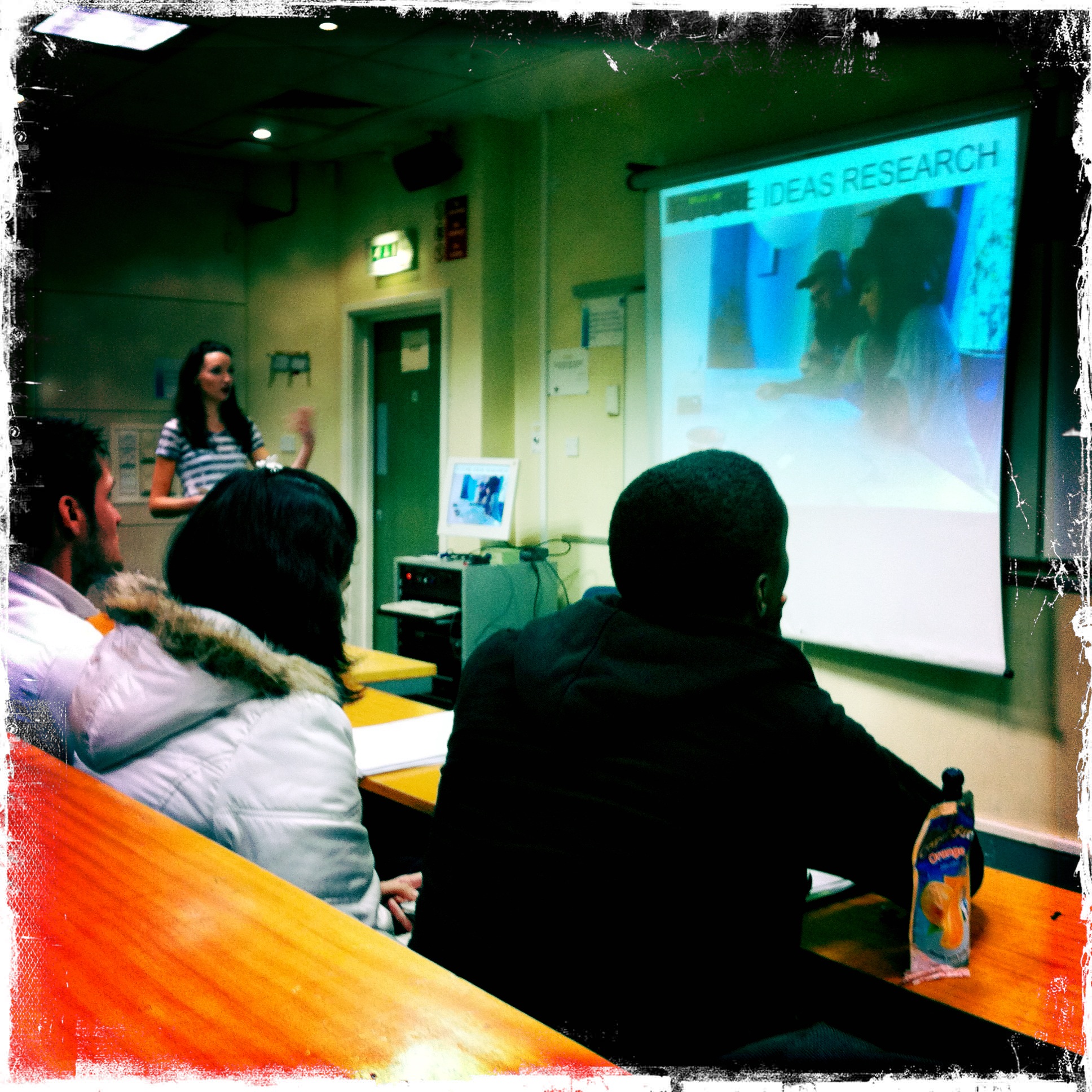
presenting sqoshi to MMU students

I seem to be doing a lot of presenting to students recently. I’ve been conducting some really interesting focus groups with school kids and teenagers for one of our clients, and today I had the opportunity to give a talk to Postgrad marketing students at Manchester Met University (MMU). I spoke to them about sqoshi.com which is my own project that i’ve been working on for the last couple of years along with two partners. I conducted A LOT of research (both primary and secondary) for sqoshi from pre-concept to the present day and of course it’s something we’ll continue to do as listening to our users is of the utmost importance. It is this research process that I presented to the students and hope they found it useful to see how much research you need to do to create a new business.

Before sqoshi, we had intended to pursue a different project idea that would have taken a very long time to develop and would have failed. Because we spoke to real people at the concept stage (and importantly listened to the feedback) we realised quickly that the idea didn’t have legs and we canned it asap. Best decision ever!

Some businesses do research but make the mistake of letting their pride get in the way so they fail to listen to the user feedback if it disagrees with what they want to hear. This is worse than doing no research! It’s so important to take onboard all feedback with an open mind and decide how to utilise the findings in a productive manner because at the end of the day even if there is a lot of negative feedback you can at least work with that to improve your product. It’s better to accept this sooner when changes are cheaper and easier to make and more of your users will then experience your redesigned, fantastic version rather than the old version that left a worse impression.