Category: Psychology
The paradox of choice
The video below is of Barry Schwartz talking about the paradox of choice. It’s something that faces us all everyday. Choosing what to buy is not as easy as it used to be. Simply popping to the corner shop to buy bread takes longer due to the enormous array of different types of bread available. Online shopping takes us a lot longer due to the amount of incredibly similar products and the fear that we may make the wrong choice. For the average person, this fear leads to many hours of researching and reading reviews so they hopefully make the correct choice.
Too many choices leads to Paralysis
If you ask them, people will tell you that they like choices. Choices equal freedom. However, as Barry notes in the video, it has been proven that offering more choices actually makes choosing more difficult and ultimately to not choosing at all. More choices actually puts more stress on the person making the choice as they have to weigh up all the pros and cons of each. Eventually they either put it off until another day or they give up altogether. The solution is to offer the consumer less choice. You can also guide them into making the correct choice (or the choice you really want them to make!) via persuasive design.
Making choice easier with persuasive design

Through intelligent design, we can lessen the negative effects of the paradox of choice. Basecamp’s pricing page has been designed to entice the user to the Premium plan. The benefit of this design is the user feels they have choices (yet not too many) and control yet the decision making is less taxing as it has already been done for them.
I just want coffee flavoured coffee!
The comedian Denis Leary performed a hilarious rant on his Lock n Load tour about how difficult it is to now buy coffee flavoured coffee. It certainly highlights why keeping choices to a minimum is a good thing and less stressful for consumers.
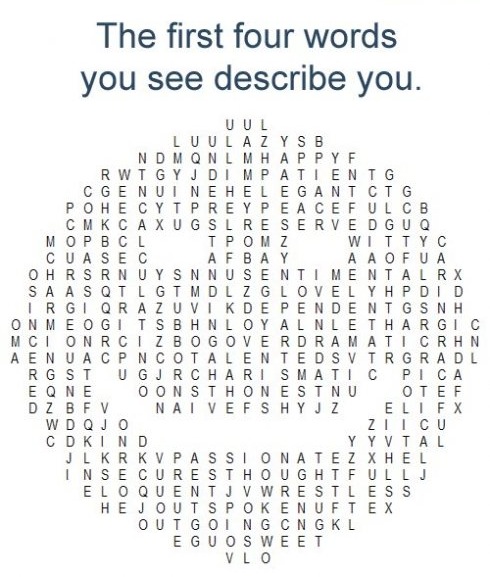
Psychology exercise: Which 4 words do you see first?
A bit of Friday fun! Glance over the word image below and write down the first four words that you find. Ok? These are supposed to describe you. I’m not sure how accurate this is as I can’t find the original source online, but it’s fun to do.
What are the four words that describe you? Post them below!

Move Over Maslow! The Users’ Hierarchy of Needs
Back in 1943 a psychologist called Maslow published what he termed a ‘hierarchy of needs‘ that can be applied to every human being. At the bottom level are physiological needs that every human needs to exist, like shelter, food and water. At the very top are factors that contribute to a feeling of self-actualization, like morality and creativity. You can read more here. The triangle shape is deliberate, in that there are a much greater number of people at the physiological level and only a small number who reach self-actualization.
We can apply Maslow’s concept to the user and their experience of any product or service. Starting from a base of does the product or service perform at a basic functional level to the ideal of the user being so engaged that they lose all track of time and enter a state of flow.
Take a look at the Users’ Hierarchy of Needs below and think about where your product or service fits. What actions are you taking to step up to the next level and improve your users’ experience?

Free Human Centred Design Toolkit
I really love the word ‘Free’ don’t you? So as well as checking out the free online ‘Search User Interfaces‘ book by Marti A Hearst, make sure you also download your free Human Centred Design Toolkit!
The Toolkit, designed by the guys at Ideo, is divided into four sections:
The Introduction will give an overview of HCD and help you understand how it might be used alongside other methods.
Download the Intro Guide.pdf
The Hear guide will help your design team prepare for fieldwork and understand how to collect stories that will serve as insight and inspiration. Designing meaningful and innovative solutions that serve your customers begins with gaining deep empathy for their needs, hopes and aspirations for the future. The Hear booklet will equip the team with methodologies and tips for engaging people in their own contexts to delve beneath the surface.
Download the Hear Guide
The Field Guide and Aspirations cards are a complement to the Hear guide; these are the tools your team will take with them in order to conduct research.
Download the Field Guide
Download the Aspirations Cards
The Create guide will help your team work together in a workshop format to translate what you heard from people into frameworks, opportunities, solutions, and prototypes. During this phase, you will move from concrete to more abstract thinking in identifying themes and opportunities and back to the concrete with solutions and prototypes.
Download the Create Guide
The Deliver guide will help catapult the top ideas you have created toward implementation. The realization of solution includes rapid revenue and cost modeling, capability assessment, and implementation panning. The activities offered in this phase are meant to complement your organization’s existing implementation processes and may prompt adaptations to the way solutions are typically rolled out.
Download the Deliver Guide
Thanks to all the guys at Ideo for sharing this fantastic Toolkit with us.
How Personality Can Predict Media Usage
Just read this really interesting article on how our personality may be a better predictor of our media usage than standard focus group tests.
Here is one example of a ‘dynamic person’:
“Dynamic people don’t watch TV… are 50% more likely to watch less TV than the average person and are 59% more likely than the average person to watch less than an hour of TV daily. Dynamic people are also 45% more likely to buy movie tickets online and 26% more likely to describe themselves as Mac people. “The lesson here is that if your core target is really dynamic, open and assertive, TV may not be the best place to reach them.”
It seems I’m dynamic as I only have a few tv programmes that I must watch (Lost, The Apprentice, Come Dine With Me), I prefer to buy cinema tickets online so I can walk right past the long queue of people waiting in line and I am definitely an Apple fan. So bearing this in mind, the TV is definitely not a good place to advertise to me. In fact, most often I haven’t got a clue about adverts as I never watch them – I’d rather skip channels.
Read the article and see which category you fall into!
Right Brain vs Left Brain Test

Click on the above picture to be taken to a page (Daily Telegraph) where you will see the above lady spinning around. She will spin either clockwise or anti-clockwise depending on whether the left or right side of your brain is most dominant. This works!
Can you resist?

 Lisa Duddington