

The Psychology of Colour

Featured in The Guardian
 What better way to start the year than a guest appearance in The Guardian!
They seem to have cut the photo in a way that looks like my head’s been chopped off, so erm, just ignore that and read what I say instead 🙂
Read the article and check out my chopped off head on the guardian.co.uk >>>
How to make dogs drive cars and users click buttons
My latest post on Keepitusable about behaviour is now live and it’s a good one!
I explain the importance of understanding, researching, analysing and changing behaviour. Using BJ Fogg’s behaviour model I look at what contributes to a desired behaviour occurring or failing and how we can turn a user into a buyer through analysing the psychological buying process pyramid.
Here’s an extract from the article:
“Who would have thought that dogs could be taught to drive cars or that double the amount of users would click a button just through a simple design tweak.
Behaviour is fascinating. Not only can we research, analyse and understand behaviour, it is possible to then actively and deliberately change it. It isn’t easy or quick but if you get it right the results can be incredible. But human behaviour has deep, complex motivations and meanings which is why it’s vitally important to have at least one person involved in your project who has a solid background in psychology.
A good starting point for understanding behaviour is the work of BJ Fogg. His behaviour model states that three elements must converge at the same moment for a behavior to occur: Motivation, Ability, and Trigger. When a behaviour does not occur, it means that at least one of these key elements is missing….”

Motorola announces the HC1, Headset computing.
Information Architecture (IA)
Have you ever been to a website specifically to look for something and no matter how hard you look you just can’t find it? Most people will give up within a few seconds, hit the back button and go to a competitor. This is why your Information architecture is incredibly important – get it right and you will keep more people within your site, lowering your bounce rate and improving your conversion.
What is information architecture?
In simple terms, it’s about structuring your content to feel intuitive and logical to the end user.
An example of how not to do it
Tesco Direct have placed Halloween items within the heading ‘Christmas’ on the navigation bar. Users will struggle to find this as it makes no logical sense – halloween and christmas are completely separate occasions.
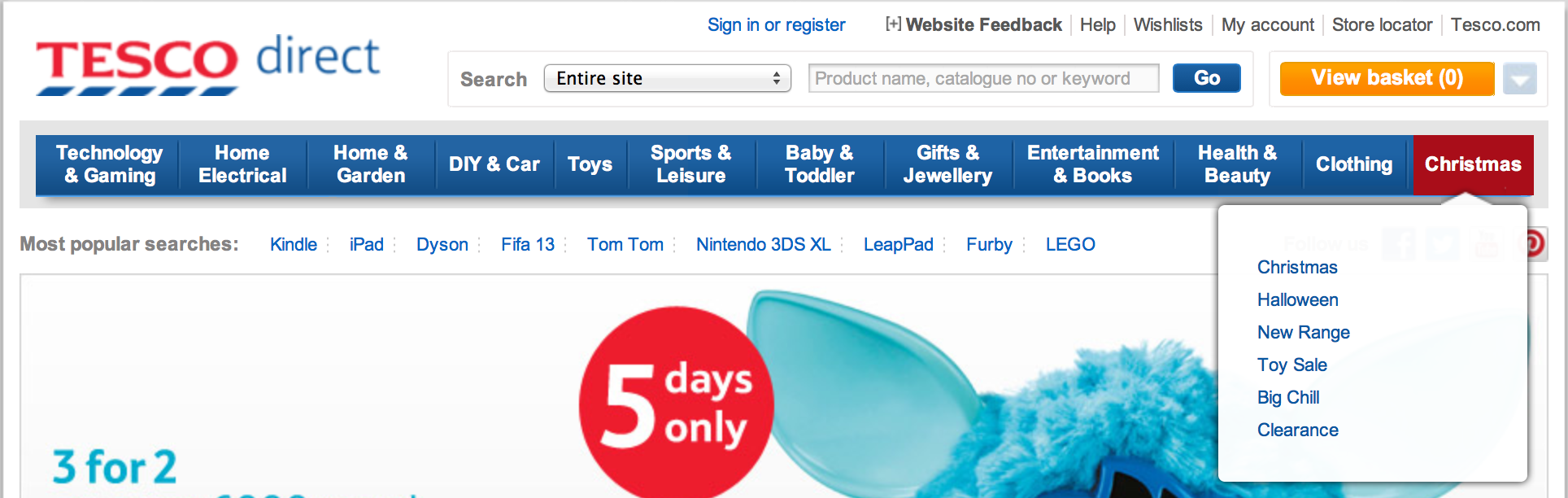
If a visitor to your website has the intention of browsing halloween things, they will already have expectations of where halloween things will be. Your aim is to try to understand their expectations of where they’ll find halloween related products. Only when you understand this, can you position it in the optimal place.
Card Sorting to create intuitive IA
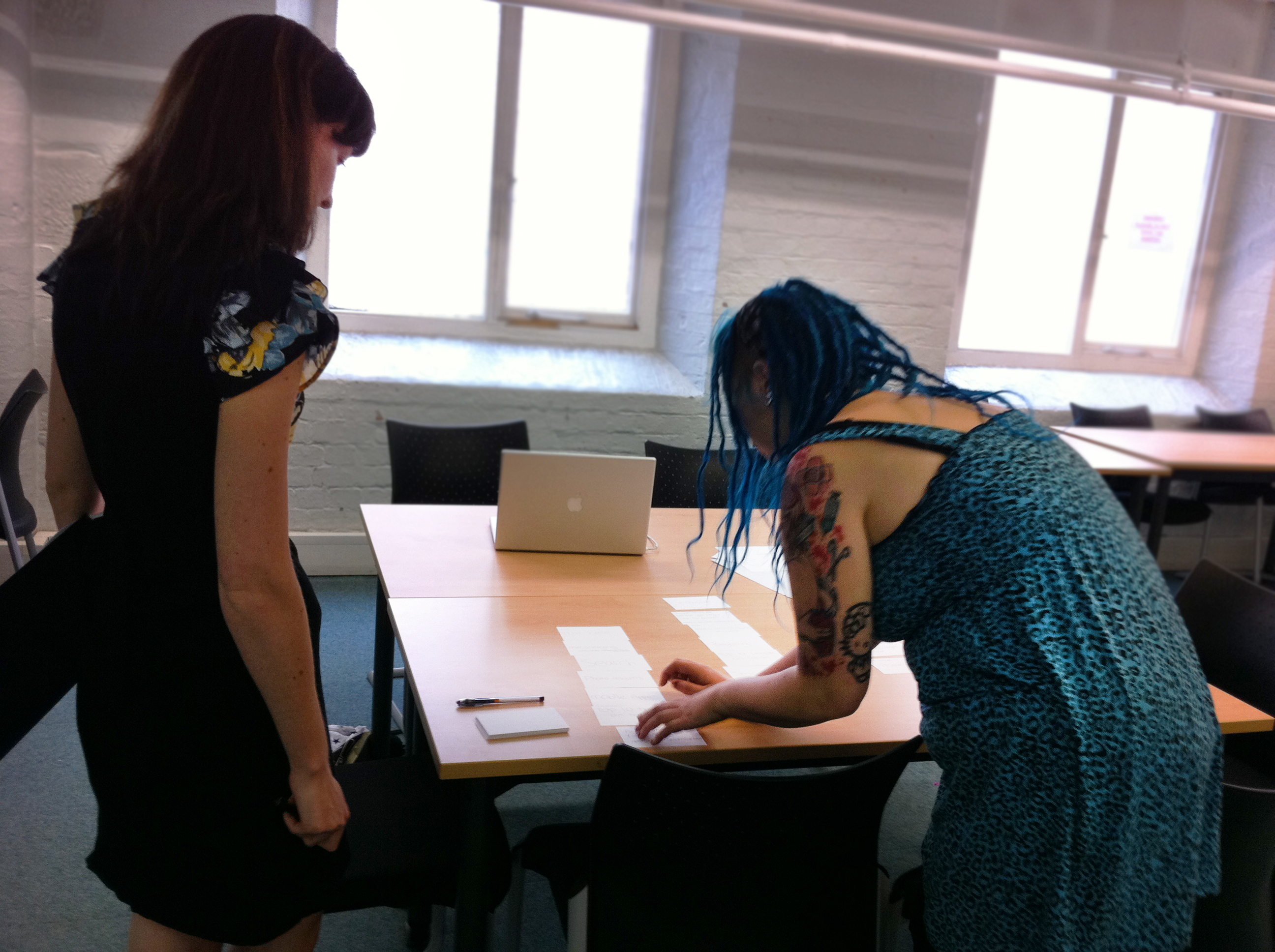
One of the methods I employ to help create intuitive Information Architecture is Card Sorting. It’s an activity carried out with users (i.e. your target audience) using labelled cards to group and organise pages of content. Users categorise the pages in the way that makes sense to them and they can use existing grouping or create their own. What this enables us to do is to see the structure of your site or software from the user’s point of view – we can see and understand their mental model.
Card sorting exercise in action:
 If you’d like to understand more about how reviewing your IA can help your business or if you’re curious about card sorting please don’t hesitate to get in touch.

Organic Search Results and their Impact on Paid Search Ads

Intelligent UX: Washing Machines
UX Booth guest post: 5 Useful Lies to Tell User Research Participants
 Do you read UX Booth? If you’re interested in User Experience then bookmark it now! It’s been my favourite site for reading interesting and useful UX articles for a number of years now. As such, when I decided to write a guest post, they were my first choice. I decided to write about 5 little (white) lies that can be told during user research interviews to gain higher validity data.
I’ve conducted hundreds of research interviews and I’ve picked up a few useful techniques along the way to encourage the best out of the people I interview. This includes making them feel more at ease, increasing rappor, gaining trust and encouraging an open dialogue where it is ok to be 100% honest.
Active and passive deception has been used in research for a long time. In the past it was unfortunately used unethically and there are a lot of examples out there of how not to use deception. The Milgram experiment is one of the most known for the psychological and physical damage it caused.
Of course, all the lies I use and recommend are incredibly nice. They’re white lies and many UX researchers use some or even all of them. You don’t have to use any but they are a useful tool to have in your UX toolbox. Enjoy! 🙂
Read the article: 5 Useful Lies to Tell User Research Participants
New Next Gen Macbook Pro
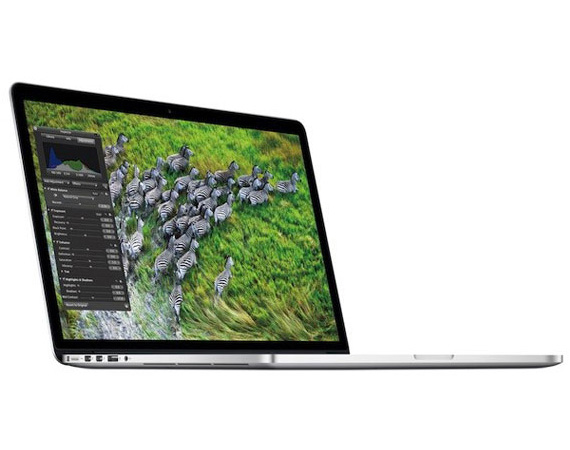
“It’s without doubt the best computer we’ve ever built!”
If you’re an Apple fan then you’re probably feeling pretty excited right now. WWDC was held yesterday (you can watch it here) and Apple have finally launched the next generation of Macbook Pros. Thankfully they’ve met and exceeded most people’s expectations, with the new Macbook Pro showing off an incredibly slim casing, superb retina display, high performance and attention to little details such as the lowering the noise of the fan (yes seriously!). I don’t know of any company that would value the user experience to such detail.
New Macbook Pro Overview:
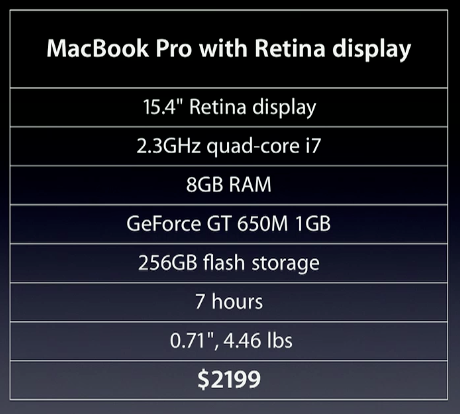
It’s very impressive and I’m already reaching for my purse. The question is whether to wait until July which is when Mountain Lion is released. There’s a free upgrade for anyone purchasing the Pro if you buy now, or like my other half plans to do, you could wait until next month which also gives Apple some time to solve any issues there may be with the new hardware design.
I’m not as impressed with iOS 6. It may surprise you to know that I’ve never owned an Apple mobile, despite my love of all things Apple (well, except iTunes which needs a complete redesign). For most people, their mobile is an extension of themselves, of their own personality. I find the iPhone form factor to be quite masculine. It feels expensive and high quality but I just can’t connect with it. There is one thing that keeps pulling me to Android and that is Widgets. As far as user experience is concerned they enable a shorter, more efficient and effective interaction. I can simply turn on my backlight and I instantly know the weather, the latest news, read a note to myself (usefulness), and I can see a photo of my other half with the cats (emotional attachment, love). It all adds up to a nice experience. iOS may have better usability and apps than Android, but I personally believe they need to add more fun, emotion, usefulness and wow factors into their mobile desktop to have increased emotional appeal.
Getting back to the new Macbook Pro, here are a few quotes from WWDC relating to User Experience that I wholeheartedly agree with.
“To create something that’s genuinely new, you have to start again and I think with great intent you disconnect from the past.”
“If you never change anything then what you can engineer is kind of incremental. But when you’re willing to change things then you kind of open up a whole new world of design.”
 Lisa Duddington