UX Videos: I luv great ux design
I’ve just seen these great videos on vimeo that explain what a user experience designer does. They’re really fun and I hope you enjoy watching them as much as I have.
Part 1:
Part 2:
Eye tracking – Should your website use it?
This week I’ve been visiting local usability labs that have eye tracking capabilities as we will soon be offering this added value service to our clients.
What is eye tracking?
Eye tracking uses non-intrusive technology to track where the user’s eyes are looking. It is often used for usability testing websites, software, mobiles, adverts, even shopping malls (there’s a lot of psychology that goes into where to place that can of Heinz!).
Testing involves the user using a website to perform tasks and is often accompanied by a satisfaction questionnaire. Afterwards, the users gaze path and fixations (basically what they looked at and for how long) can be watched and analysed. All the users data can also be combined into a heatmap so you can see which areas of each page attracted the most attention from users – did they even look at the big advert in the middle of your homepage?
Is it worth the extra time, effort and cost?
There’s a lot of disagreement amongst professionals as to whether eye tracking is worth the extra time and effort required to analyse the data and whether it really brings more value to usability testing. From speaking to those professionals that do use it, it is clear that businesses and in particular marketing departments are more persuaded and engaged by this testing method. Perhaps this is because marketing departments are more concerned about users noticing their promotions and advertising than finding out the hows and whys of users that visit their site.
I’m of the opinion that some websites are better suited to standard usability testing methods, some are better suited to eye tracking and others may benefit most from a mixture of both.
Video showing user’s scanpath
(the bigger the circle, the longer the user is looking at that point)
Video showing the use of heatmaps
Eye tracking is most useful when you want to test:
- Page elements – To assess how much people notice ui elements onscreen, such as logos, promotions, calls-to-action, etc.
- Navigation – To identify any conflicting terms as well as how different navigation layouts interact with each other.
- Page layout – To show how a page layout and colour scheme affect the way users scan a page.
Eye tracking is least useful if you want to:
- Gather user feedback – In order to generate an accurate heat map users can’t be asked too many questions as they’ll often look away from the screen when answering questions.
- Know why – Eye tracking will tell you what people look at and what they don’t look at but it won’t tell you why.
- Test on a budget – Eye tracking is more expensive as it involves the hiring of technology and extra time to analyse the results. Stick with regular methods if you’re budget is limited.
I hope this basic introduction to eye tracking has been useful. If you are interested in seeing how real users actually use your website (with or without eye tracking) then give me a shout. You can observe the user testing in person (in the observation room) or we can stream the sessions live from the testing lab directly to your computer.
Secrets to successful attention

Everyone wants it. How can you make it work to your advantage? Read on…
The 10 minute rule

People’s ability to pay attention greatly decreases after 10 minutes. This is bad news if you’re a teacher or if you do a lot of presentations at work. However, what you can do is design your presentations with this rule in mind so that you do something at each 10 minute interval to re-engage your audience.
Multi-tasking is a myth
 Did you know that we can’t actually multi-task? What actually happens is the brain switches between tasks in quick succession because it functions sequentially.
It’s more efficient and effective to do one thing at once
It takes you 50% longer to complete a task if it’s interrupted because the brain has to carry out four time consuming steps each time you switch tasks. Studies show that you’ll also make about four times more errors.
Sex, food and danger
 When we were cavemen (and women!) life was hard so our brains learnt to respond to the 3 basic things that kept us alive. Sex ensured the continuation of our species. Acquiring food and avoiding danger kept us alive. Although we’re not cavemen anymore our brains still respond to these 3 stimuli. That’s why you see these constantly in adverts – brands play on these as they work on a subconscious level.
Why not think about the above and how you can apply them to your work to get more effective results and make more efficient use of your time.
30 excellent free ux tools
uxforthemasses.com have created a great list of 25 free ux tools for doing things like prototyping, annotating, screen grabbing, site mapping, usability testing, accessibility and analytics (thanks guys!). Some of the items aren’t really free (they just have a free trial), i’ve included them anyway as they’re still really useful and i’ve added a few of my own.
Prototyping tools
Flairbuilder (15 day free trial)
Powerpoint (Open office version is free)
Annotation tools
Design tools
Pen and paper! The simplest and arguably the best. Frees your mind to be creative, can be used anywhere and is ultra quick.
Screen grab tools
Cmd shift 4 – If you’re using a mac you can use cmd shift 4 to capture a portion of the screen or cmd shift 3 to capture the whole screen.
Print screen – On Windows PCs you can just use the print screen function and paste it into Word, or Powerpoint if you want to do a click through prototype.
Sitemapping tools
Usability testing tools
Remote usability testing tools
Silverback (free for 30 days)
Usability reviewing tools
Analytics tools
Accessibility tools
Intro to persuasion and social influence
Many years ago, when I was a student working as a project administrator in my spare time, my manager asked me ‘If you could have any super power, what would it be?’
I thought about this and decided i’d want the power of invisibility. I guess this makes sense now, considering how much i enjoy observing and analysing human behaviour – you need to be truly invisible to not have an observer effect. My manager however decided upon the power of persuasion. He said if he had the power to persuade anyone to do anything he could do and have whatever he wanted in the world.
Luckily for us, persuasion is something that can be learned, practised and used in our daily lives. Brands leverage many principles of persuasion to convince us of their value and to purchase their product.

It is no coincidence that the Loreal adverts now show Cheryl Cole as their brand ambassador. She is officially the most liked female in the uk. People are more likely to trust her and be persuaded by her as she has a very high ‘Like’ factor. She also provides ‘social proof’ however there is more resistance now to celebrity social proof as people look more towards their peers for advice.
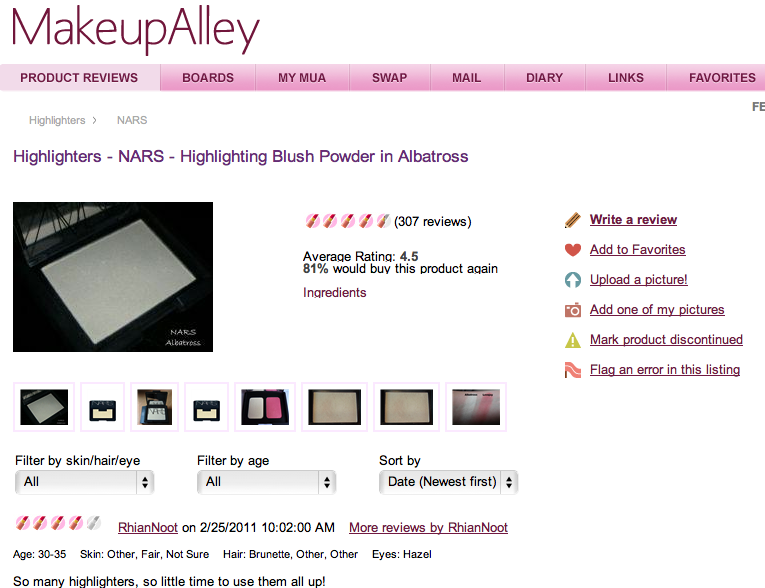
Sites such as makeup alley (shown below) rely on social proof to work. Users can read what their peers think of products, they can see the rating they gave it, what percentage of people would buy the product and importantly, they can see that the people are real.
Companies often use scarcity to act faster or pay more. Below is an example from a website that sells bedroom furniture. They use both limited time free delivery and a limited number of free drills to try to persuade the customer to purchase their products soon, otherwise they will miss out. People have a fear of loss so the thought of potentially losing something that is ‘free’ (another motivator) can be enough to get them to act.

We all look to experts for advice and recommendations. Even amongst our peers, we have experts who we turn to for advice. For example, if you need a new TV you might ask cousin John as he always knows a lot about entertainment systems. Or if your cat is ill, you might ask your friend Sarah for advice as she’s got 3 cats and is cat crazy! Each person is highly persuasive in their own way.
Persuasion is a fascinating subject area and i’ll be covering it in more depth in future posts, in particular how you can design to persuade.
ROI of User Experience
The Return On Investment (ROI) for companies that include user experience in their process can be enormous. Here are some facts from the IEEE:
15% of all IT projects fail due to being inadequate.
50% of developer time is spent on avoidable rework.
£1 before dev >>> £100 after dev. The cost of fixing something after development is 100 times more than before development. Include user experience as soon as possible!
Watch the video:
Wikipedia to have a usability makeover
The founder of Wikipedia, Jimmy Wales, has admitted that contributing content to the site is too difficult and that it is effecting the growth of the website and also the types of users who contribute.
When formatting articles on Wikipedia, the user is faced with complicated code, known as a wiki mark-up. This is very intimidating for the standard user who will often exit at this point. This leaves only the Wiki ‘expert users’ contributing and alienates other users who may not be as technically savvy.
“If you click edit and you see some Wiki syntax and some bizarre table structure – a lot of people are literally afraid. They’re good people and they don’t want to break something,” Jimmy Sales told the bbc.
Wikipedia, the world’s fifth most popular site, want to grow their user base from 400m to 1.5bm by 2015, they also want to attract more female contributors. They recognise that they can’t grow unless they redesign their interface to be more easy to use. One of the ways in which they plan to do this is by introducing more WYSIWYG tools (what you see is what you get).
It’s great to see Wikipedia recognising their usability issues and addressing them. Hopefully other companies will see this as an example of how good user interface design can actually increase your number of users and grow your business. It’s not all about marketing!
Book Review: It’s not how good you are, it’s how good you want to be
Oh gosh, I didn’t realise it had been this long since my last post… I WILL post more this year! Which brings me nicely onto my first book read of the year which i just finished yesterday (it actually arrived yesterday too which shows you how quick this one is to read!). It’s a very good motivational kick up the backside book to get you going for the new year and it’s called It’s Not How Good You Are, It’s How Good You Want To Be
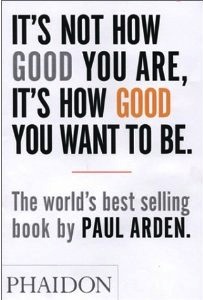
It’s small, easy to read, lots of pictures to break it up and handbag sized which is handy because this is just the kind of book you should always have handy as a quick motivator. I don’t want to spoil the book for you, but here is a sneak preview of some of the tips.
Don’t seek praise, seek criticism
This is one I champion. You can only grow as a person and a business if you ask for honest opinions, digest them and work out how you can make it better next time. None of us are perfect and we probably never will be, but we can all make an effort to work towards being better than we currently are. Take risks, accept new challenges, create goals and definitely seek criticism. People find it much easier to give praise than criticism so you will need to seek it out and accept it enthusiastically, no running out the room crying (I’ve heard of this happen a few times!).
Getting fired can be a positive career move
The book points out that this can be an opportunity to try something new and that it probably meant you and the company weren’t right for each other in the first place. I think as long as you were fired for the right reasons and not for anything bad, then it can definitely be a good thing. When I was made redundant I was personally overjoyed to be able to get out of the rut and try something new. These events are massive opportunities and it’s up to you what you make of them. I’m now working for myself, have masses of creative freedom and i’m also working on my own business projects.
Don’t be afraid of silly ideas
We all get mental blocks and Arden says the best way to get out of these blocks is to lose your inhibitions and to stop worrying about being right. He suggests doing the opposite of what the solution requires and choosing the next thing you see out of the window as the solution to your problem. There is an example which shows a very popular wine called ‘Fat bastard chardonnay’. It was an international success primarily due to it’s unusual and eye catching name. It certainly stands out from the rest!
Well I hope this has provided you with some extra oomph for 2011. Thankyou very much for continuing to read this blog and I wish you all the very best for 2011. Keep it simple, keep it usable people!

Not everybody can be as badass as Steve Jobs…
…but an exceptional product needs a clear vision, solid user research, an experienced designer and a management willing to take some risks.
my favourite excerpt from this great user experience article by Oliver Reichenstein
 Lisa Duddington